A philosophical essay by the sweet Tikami
Zero Risk
Zero risk does not exist. That is a cliche that pops up automatically to extinguish the concerns of the crowd; for instance when a pharaonic skyscraper is planned on a seismic zone, when a cosmetic product stuffed with novel substances makes its entrance onto the market, or when a petrochemical plant sets up downstream of a hydraulic dam and upstream of housing.
Zero risk does not exist. That is true. But it is also a statement entirely devoid of relevance, one that knowingly exploits what one might call “safety relativism”. For it is not because zero risk does not exist, that all the different ways of doing things are therefore equally valid.
The Risk Curve
In reality, there is systematically a trade-off to be made between the safety efforts implemented and the resulting statistical risks. In my experience of life, this nearly always produces a curve resembling this one (shaped like an “inverse 1/x function”, my human told me).
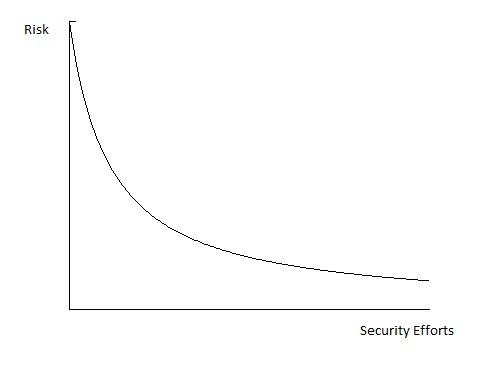
This curve will never reach a vertical zero, even if humanity deploys every means at its disposal. But with a few small efforts, a little time spent thinking, a little financial outlay, one drops from a “maximal risk” to an “accepted and owned risk”.
Examples
The human infant is without question the most suicidal creature that has ever existed. Yet with about ten simple measures (blocking electrical outlets and cupboard doors, securing climbable furniture to the wall, not leaving small objects lying around that it could swallow…), the risk of a serious domestic accident becomes almost negligible.
It is not currently possible to predict every interaction a new molecule may have with the ecosystem and the human body, especially when it comes to long-term effects through endocrine disruption. But with rigorous, long-term testing, a health-monitoring system free of conflicts of interest, and precautionary abstention for sensitive populations (pregnant women, children…), most serious risks end up contained.
In sexual matters, each of your protections against disease transmission or pregnancy is, taken in isolation, far from convincing; I have never understood what “98% reliable” is supposed to mean, but it sounds a lot like a game of Russian roulette with a rather large cylinder. On the other hand, combine these protections (medical screening + condom + the pill, or replacing the pill with fertility-cycle monitoring), and you fall into statistical oblivion, into risks so tiny that no one could ever truly guard against them - short of abstaining altogether.
I could go on with examples forever. Any trip abroad carries risks, but with a few specific vaccines and precautions (e.g. not drinking tap water, sleeping under a mosquito net), the danger is divided by an enormous factor. Scuba diving is, by its very nature, harsher on human physiology than football, but after a bit of dedicated training (clearing one’s mask, sharing someone else’s tank, monitoring decompression stops), it looks rather tame next to the pile-up of torn cruciate ligaments and head injuries that rain down on Sunday footballers. Lightning strikes wherever it pleases, and one cannot walk around permanently carrying a lightning rod, but avoiding standing under trees or in crevices during storms will leave you more or less immune to that particular risk.
As we can see, then, this “zero risk” motto contributes nothing to the debate; it mostly serves as a mask for intellectual laziness, cynicism, and other none-too-flattering human traits. Let us note in passing that, more often than not, the people who invoke this “absence of zero risk” are not the ones threatened by the ventures they are advocating for; wonders of human hypocrisy.
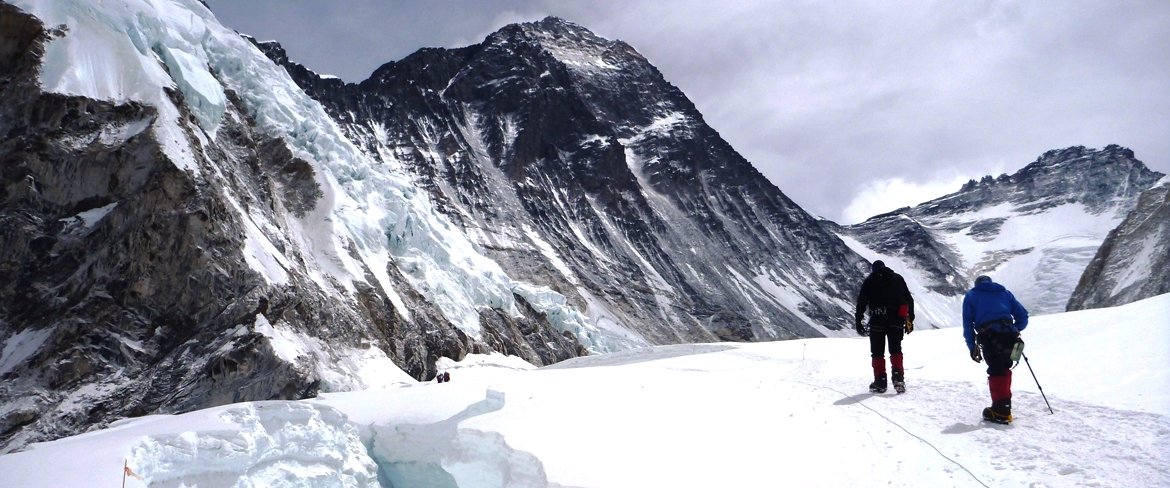
Prudence is not the opposite of boldness (whose opposite is faintheartedness), nor of optimism (whose opposite is pessimism), but of recklessness. The difference? Recklessness shuts itself away in its own ignorance, closes its eyes, and crosses its fingers; whereas prudence methodically analyzes, takes sensible protective action, assesses the remaining risks, and fully owns them. Following such discernment, one person may still wish to climb Everest, while another will settle for walks in the forest; there is no disputing taste.
Prudence is not the opposite of boldness or optimism, but of recklessness.
Of course, prudence has another enemy: excessive prudence. Some people confess to their fear, whenever they go out, that the cinema might catch fire, that the subway ceiling might collapse, that every person they pass might strike them… Here we are dealing with a pathological hyper-anxiety, even a paranoia requiring psychiatric treatment. Everyone can plainly see how harmful it is, so I will not dwell on it.
Paralytic Perfectionism
I must, however, shine a light on a related intellectual bug, one I shall call paralytic perfectionism (or “sclerotic perfectionism”, that works too). Mind you, this is not the “precautionary principle”; the latter is merely a particular case of prudence, applied when the unknowns are too great regarding the risks of a new product or service compared to the benefits it might bring. Rather, it is this way humans have of clinging to a highly unsatisfactory situation, on the pretext that the alternatives offered to them are not flawlessly perfect.
Take, for instance, the much-publicized case of “anti-vaccine” activists. Because vaccines are not 100% effective, because they exceptionally give rise to unpleasant side effects (like any medicine), because exceedingly murky rumors have circulated about a possible link to autism, anti-vaccine activists prefer the status quo of the “natural”. That is to say, the thousands, the millions of deaths and disabilities that outbreaks of measles, rubella, and whooping cough will inevitably cause should herd immunity collapse.
The same goes for politics, where citizens cling to one of the worst voting systems in existence (first-past-the-post majority voting), yet balk at the most trifling flaws of alternative voting systems (majority judgment voting, Condorcet voting, instant-runoff voting…); where they endure, day after day, the oppressive absurdity of representation through elections, yet shrink back behind fears, uncertainties, and doubts the moment more democratic systems, drawing on subsidiarity and sortition, are proposed.
A similar phenomenon occurs in the technical world, where certain aging engineers find it far easier to spot the specks in newly available technologies than the beam in the one currently in place (whereas, conversely, it is true, young colleagues will rush headlong at the latest software fad without ever assessing its actual merits or the cost of the transition).
Paralytic perfectionism, by preferring serious and certain inconveniences to more or less hypothetical flaws, by dishonestly justifying clinging to “tradition” in the face of proposed changes, is a non-negligible brake on humanity’s progress; let us therefore learn to spot it.
We can see, then, that the “zero risk” saying, however true it may be, does not really belong in a debate over accepting or rejecting some novelty. The questions actually at stake are rather those of the balance between benefits and risks, the reliability of statistical estimates, the size of the population at risk, the consent of said people… questions that, one senses, can only be settled within the framework of a genuinely democratic debate.
 A glimpse of the author, the Tikami