A philosophical essay by the sweet Tikami
Tintin in the Congo
I would like to address, at present, a subject that is far from crucial to the future of the human species, but which I find highly illustrative of those intellectual bugs, those ideological pitfalls, that discredit you so thoroughly. I am speaking of the comic book Tintin in the Congo by Herge, which has periodically found itself at the center of controversy since its first release in 1930.
The Work and the Controversy
This album was rewritten in 1946, then reissued many times over by its author or its publisher. One would therefore be entitled to think that it is no divine, untouchable work. Herge wrote it at the urging of Father Norbert Wallez, who would later go on to support Leon Degrelle. I leave it to you to look up these characters; fear of fascism and of Holocaust denial was certainly not what kept them up at night.
The author himself later distanced himself somewhat from his work, for instance during a radio broadcast:
« This album is a youthful indiscretion. One can clearly sense it is pure fantasy. I did it very carelessly, I must say, relying mostly on hearsay, on what colonials back from over there used to say, on a few travel accounts… I do not disown it, but I would do it very differently today. To begin with, I would go there myself, I would do my research, I would immerse myself in the atmosphere of the Congo. »
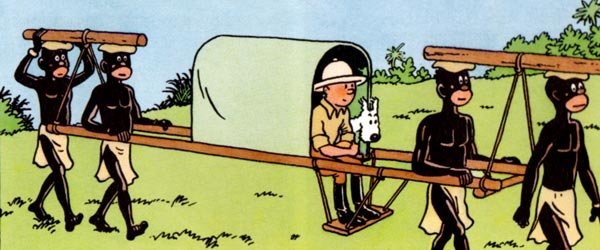
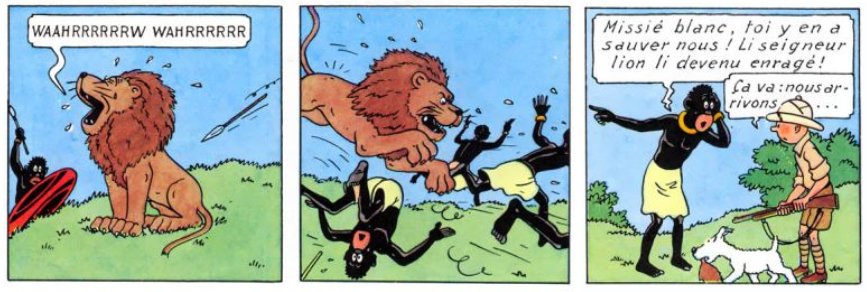
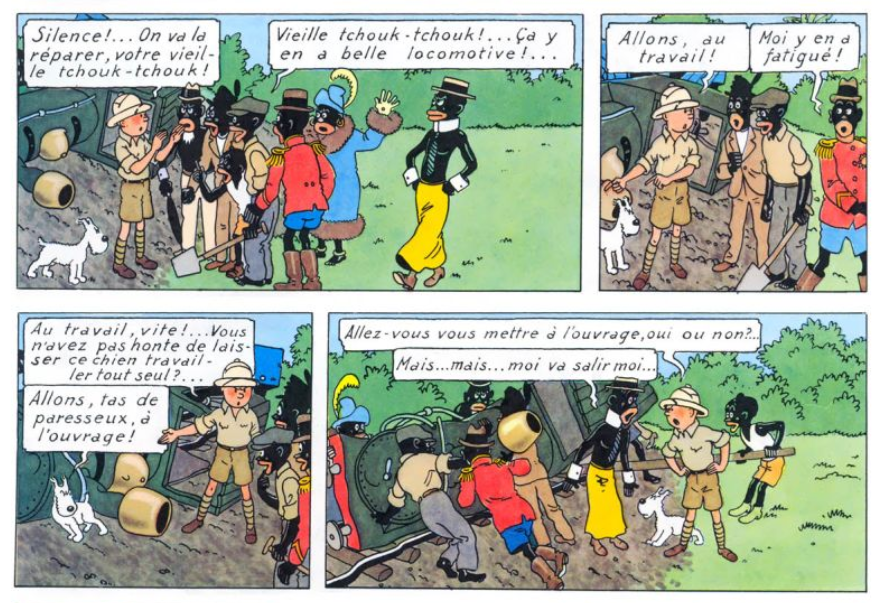
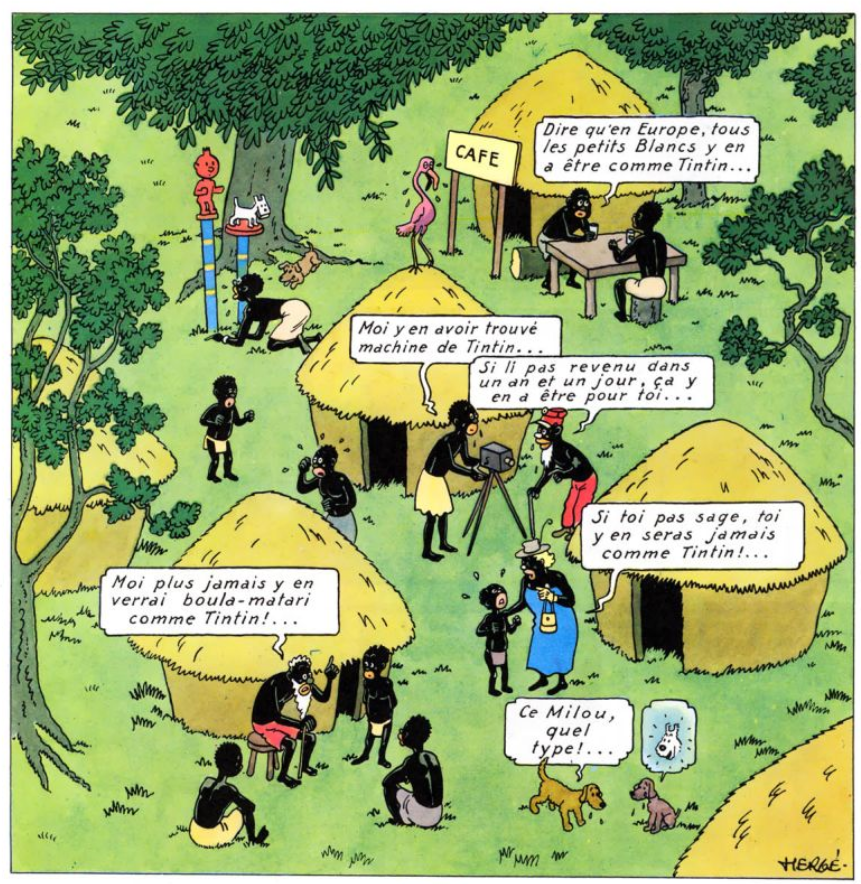
And what we must, in all honesty, acknowledge, is that this comic book teems with details that give one pause. It features Tintin, sent to do a reportage in the Congo; who, in point of fact, spends most of his time gunning down antelope, buffalo, rhinoceros and elephant; who remains brave while the black characters flee at the approach of the slightest predator (lion, leopard…); who dispenses justice among quarrelsome natives; who cures the sick; who, wherever he goes, gets carried about like a king by marveling black characters (Snowy is even crowned king by pygmies); who attempts to teach their children, alas without success, how much “2 + 2” makes. More generally, a Tintin who meets only natives who are, depending on the panel, lazy, childish, credulous, or malevolent…
Granted, one cannot accuse this work of being hateful toward black people. White characters play the great villains in it, and the success it still enjoys today in Black Africa shows that it can also be read as mockery of the self-satisfaction and prejudices of Belgian colonists.
That said, one cannot deny that it is emblematic of Belgian paternalism; a toned-down, yet insidious form of racism, for it dresses up, in good sentiments, the domination of a people unilaterally deemed too childlike to develop without delegating its sovereignty to a “civilized” country.
This album has therefore been censored on several occasions, particularly in a context of decolonization. Nowadays, in France, such a measure would be excessive and counter-productive (see the Streisand Effect). But since this comic book continues to wound some Africans, since complaints are still occasionally filed against it, why not show some willingness toward conciliation and appeasement? For instance by shelving it in the “adult” section, as a number of Anglo-Saxon shops seem to have done? Or by appending to it, as the most recent complainants ask, an explanatory note?
But there you have it: among humans, the sanctification of works often comes before that of humans themselves. This little controversy therefore stirs up some good old acquaintances drawn from the “ideological symptoms”…
Slippery Slope and Bias
I have thus heard people proclaim that if one allowed a warning to be placed on this work, it would open the door to every sort of abuse, and soon one would be forced to put warnings on most existing works that touch on violence, murder, rape, and so on. Note that this “slippery slope” argument is one of the most common logical fallacies there is.
There can be no runaway contagion, simply because “Tintin in the Congo” is an exceptional work: not only has it remained famous to this day (unlike the small racist or antisemitic illustrations found in yesteryear’s newspapers), not only does it drip with humiliating scenes aimed at the Congolese, but above all it is a work aimed at a young audience, or even (for the more precocious) a very young one.
One can legitimately expect that an adult, when reading a text by Aristotle, by the Marquis de Sade, or by the Vichy regime, will be aware of the context in which the work was conceived, and of the dubious nature of certain ideas it contains; that they will know how to recognize most of its cruel theses, its rhetorical manipulations, its falsehoods; and that they will think to seek further information elsewhere if need be. But that critical distance cannot reasonably be expected of a child, that being so fascinating precisely for its credulity and its lack of scientific knowledge.
I must confess, in the very Caucasian suburb where I initially set down my bags, people of Black African origin were quite rare; and I scarcely had the chance to travel to those far-off lands. I therefore lived for more than a decade with nothing but this album, and the odd television news report, as my window onto that part of the world; and I truly pitied those poor Africans for not having more “little Tintins” to teach them how to feed themselves, how to do Science, and to keep them from slaughtering one another. It took me a while to understand that Western countries are not always as civilizing and pacifying as they ought to be, and that black people are not humans stuck at the stage of “big children”. To tell the truth, an explanatory note would have spared me these wanderings.
But here is the strange part: the very same people who proclaim that “Tintin in the Congo” must be “put back into context” are the ones who oppose a foreword that would precisely allow children to understand the oddities they are reading. As though prefacing a work were tantamount to sullying it; as though there were nothing very interesting to explain about the Belgian Congo, about the crimes committed against civilians for the exploitation of rubber and other resources, about the “Anyotas” sect that Tintin encounters, and about the various aspects — positive as well as negative — of this encounter between two cultures.
Another questionable undertone that this subject brings to light is the famous “double standard”: the very same people who are outraged when a preschool picture book depicts a boy dressed as a girl, or attacks their own identity (deities, clergy, social background…), show themselves to be remarkably tolerant when it is a foreign people being demoted to the status of sub-humans. This would almost amount to a “one-way” freedom of expression.
As we can clearly see, humans are far more easily scandalized by the idea of so much as tweaking a comic book than by the idea of humiliating their fellow humans. A strange sense of priorities. And you reap what you sow: by thus sanctifying a secular work, you play right into the hands of religious fundamentalists; do not be surprised, after that, if you no longer have the slightest legitimacy left to censor the calls to murder, slavery and bigotry that fill their own books, “dictated by the divine”.
Further reading
- “Tintin au Congo” ou la mission civilisatrice de la colonisation (in French)
- Raciste, antisémite, sexiste: Tintin sur le banc des accusés (in French)
Revision history
- 2016/11/13: Softened condescending phrasing
 A glimpse of the author, the Tikami