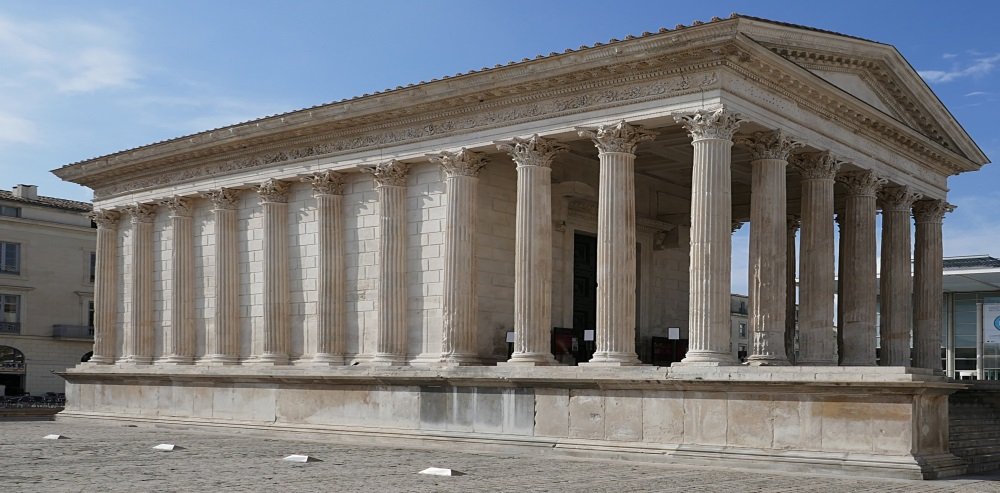
 Illustration by Carole Raddato, Creative Commons license
A philosophical essay by the sweet Tikami
The Pillars of Justice
“Justice is the first and foremost virtue of social institutions”, “Every member of society possesses an inviolability grounded in justice - or, as some put it, in natural right - which takes priority over everything, even the well-being of everyone else” (John Rawls)
It is one of the foundations of philosophy: everything comes down to definitions. And this is particularly true of “Justice”, a concept that, if ever there was one, has been worn thin by overuse.
Let us therefore posit this: Justice is the shortest path to the peace of the living. I specify “of the living”, because there are always wags ready to claim that total extermination is a decent solution to a conflict that drags on.
Once this is granted, it falls to the human sciences - starting with common sense - to dictate the proper course of conduct.
The Goals of Justice
Returning to peace - after it has been endangered by a breach of ethics - requires pursuing the following goals:
- Incapacitation
- This includes both the arrest of the criminal, and the prevention of recidivism through various means of restricting freedom (including prison).
- Deterrence
- The rare instances of police strikes teach us that, in the absence of any risk of punishment, crime skyrockets. Hence the need to preserve a certain “fear of the law and the judge”.
- Reparation
- Returning stolen goods, reimbursing or repairing damaged property, that much is obvious. When it comes to harm done to people, “compensation” is far harder to put into practice, but the principle must still stand.
- Rehabilitation
- It is just as much in the interest of society as of the criminal to see the latter reintegrate into an honest life, after having served their sentence.
Following from this, what do we observe? That at no point does Justice contain the ideas of:
- Vengeance
- On the contrary, the endless cycles of the Vendetta are in no way a path toward the peace of the living.
- Expiation
- Making someone suffer in order to appease a deity who is supposed to embody the Good - now there’s a thoroughly unexpected concept.
- Reconciliation
- Bringing a purely private phenomenon into play - whether or not forgiveness is granted by the victim or their family - in the application of justice, is not only a form of emotional blackmail, but also a guarantee of an inequitable system.
- Non-Personal Responsibility
- Punishing an individual for the crime of a relative, a community for one of its members, a class for one of its disruptive students, is a logical absurdity. A legal guardian may be guilty of having insufficiently supervised their ward, without being held personally responsible for that ward’s actions.
- Spectacle
- Between the theatrical oratory jousts in courtrooms, and the media frenzy surrounding high-profile “cases”, the serenity of judgments is hardly helped by all the commotion.
The Criteria for a Just Sanction
“We punish a breach of the social contract, not the one who committed it; the unworthiness of what was done, not the unworthiness of its author; the theft, not the thief.” (Jacques Trémintin)
You can sense it: there is one concept indispensable to achieving the goals of justice, and that is of course the fairness of the sanction. An inequitable or ill-suited justice will be rejected not only by the condemned - to the detriment of their own rehabilitation - but also by ordinary citizens, thereby undermining both its authority and its long-term survival.
So then, what sanctioning strategy should be adopted?
Any child educator will tell you: for a sanction to be fair and effective, it must be:
- Certain
- Immediate
- Proportionate
- The same for everyone
A few remarks about this formula.
First, it in fact applies to every human, regardless of age. It is one of your species’ most magnificent absurdities, to have instituted a two-tier justice system: you teach children that they must defend themselves alone against their peers, toughen up instead of going to “tattle”; and then you lament that, once grown into adults, they resort to fighting or taking justice into their own hands, instead of filing a complaint like civilized people.
Second, the “certainty” of punishment has an infinitely stronger impact than its severity. International statistics are unambiguous on this point: even by toughening the scale of sentences, even by torturing suspects, even by instituting the death penalty, a country barely moves the needle on crime. It might even increase it, in a “nothing left to lose, might as well try anything to get away” sort of way. Barring politically tinted exceptions, a criminal always bets on escaping the police, which is simply one variant of the famous optimism bias so prevalent among humans. This is why impunity, even for minor offenses, is so disastrous; this is why a justice system with minimal sentences but no way out is a thousand times better than a sadistic justice system that most crooks manage to escape.
A Few Criticisms
Why does your human justice system strike me, today, as hugely unsatisfactory? We need only run through the points raised above…
On the Fairness of the Sanction
Are sanctions certain? Between the vagaries of investigation, the lack of evidence, procedural flaws, case reclassifications, statutes of limitation, and other obstacles along a victim’s path (one who is often traumatized), it is in fact rather rare for the guilty party to be punished. The extensive immunities granted to minors make them prime targets for criminal networks, and all it takes for a defendant is to render themselves insolvent - by squandering the stolen goods - to avoid compensating their victim…
Moreover, the “certainty” of punishment is only complete when everyone has “knowledge” of what is and is not permitted. “Ignorance of the law is no excuse,” retorts the legislator. Except that, among you, “the law” has become a pile of books as thick as bricks, of which even the best students only master a fraction after years of study (criminal law, labor law, commercial law…). Spelling out the fines owed for graffiti, or how maintenance duties are split between landlord and tenant, is certainly useful, but it is not the heart of the law.
What seems to me missing from this casuistic heap is a backbone, a “judicial constitution”: a short list of great principles that everyone would learn like an ABC, and which would ground and constrain everything else. Something that would do away with the very notion of “legal loopholes”, but also with the iniquitous legalism that forces judges to apply sloppy regulations even when their consequences would be fundamentally unjust (for example, the infamous 48-hour maximum window to evict squatters). This would give rise to a “right of appeal against the imperfections of the law”, which would be resolved case by case and might, in turn, lead to a refinement of that famous “judicial constitution”.
Are sanctions immediate? The excruciating slowness of the judicial machine, and the shortage of prison space (82,000 convicts waiting for their sentence to be carried out) do not help matters. What sense does it make to be incarcerated months or years after committing a crime?
Are sanctions proportionate? The scale of sentencing is a vast topic, but it is not uncommon to see abusive spouses or sexual predators get off with ridiculous sentences, while upstanding citizens get persecuted for defending their lives with all their might, or for organizing a bingo night. And what’s the point, during a trial, of spending so much time debating the exact number of years of prison to hand down, when, between automatic sentence reductions and the highly unpredictable rulings of the detention and liberties judge, that number will remain purely theoretical?
Are sanctions the same for everyone? The statistics are painful, depending on the skill of one’s lawyer (itself tied to the budget available - or not - to hire a better one), the political leanings of the judge, the suspect’s gender, their skin color, their social status… And the “individualization of sentencing” so dear to French judges unfortunately has the drawback of injecting even more arbitrariness into judicial decisions.
On the Goals of Justice
The flaws reviewed above have, unsurprisingly, a disastrous effect on the Deterrence, Reparation, and Rehabilitation that Justice seeks to achieve. But it is Incapacitation that suffers most of all. Let us think, in particular, of the citizens who, every month, die at the hands of their partner despite countless calls for help, and those who find themselves, without any warning, facing the vengeful intentions of criminals released prematurely “for good behavior” - sometimes backed only by the flimsiest “alternatives to detention”, such as those electronic ankle monitors which, for the vast majority of them, cannot even geolocate the person wearing them.
Perfect justice does not exist, any more than the perfect society does, but it is always good to keep its fundamental principles in mind, to be aware of the achievements and shortcomings of our judicial systems, and to know how to stand up to corrupted forms of justice (trial by ordeal, vendetta…) that spend their time trying to usurp its place.
 A glimpse of the author, the Tikami